
Circulating Toxicities: Forest–River–Air Entanglements and the Social Production of Multi-Scalar Disaster in Chiang Rai, Thailand by Maya Dania et al
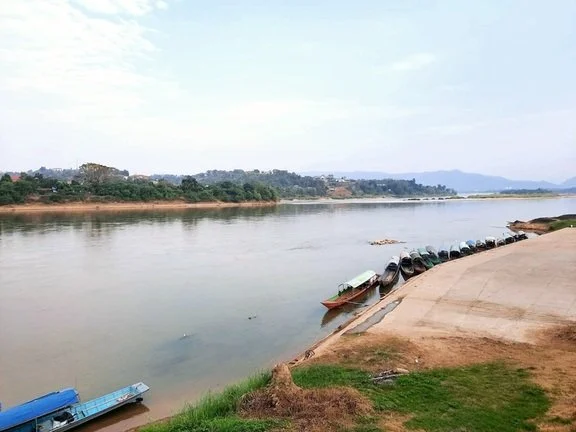
The Mekong River at Chiang Rai's northern border, where forests, rivers, and the atmosphere become interconnected pathways through which environmental toxicities circulate across national boundaries. (Photo: Reni Juwitasari)
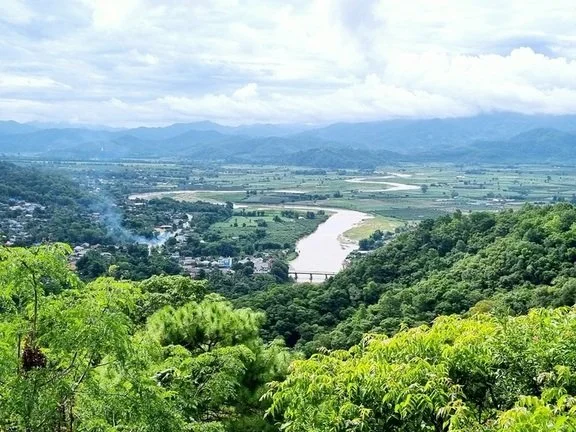
A view of Chiang Rai's forested watershed, illustrating the ecological connectivity between upland forests, river systems, and the atmosphere that underpins transboundary environmental change. (Photo: Reni Juwitasari)
Abstract
Chiang Rai is often presented as a peripheral border province of the Thai state. Yet it is precisely this location where confluences of the Mekong River system, forested uplands of mainland Southeast Asia, and increasingly intensive multinational development projects converge. It is also an unusually revealing place from which to examine how transboundary disasters emerge in the contemporary world. Pollution in the river cannot be understood without reference to upstream mining in Myanmar; seasonal haze cannot be separated from changing agricultural landscapes extending across upper Southeast Asia; nor can the ecological transformations of forests be divorced from hydropower development, regional commodity chains, or changing climate. These are not parallel environmental problems. They are different manifestations of the same regional processes through which development reorganizes ecological relations across space and time.
It is this interconnectedness that provides the starting point for the Chiang Rai Case Study, one of the flagship projects within the Research Institute for Humanity and Nature's international program, A World Ecology of Disasters in Development in East Asia: Integrating Values into Decision-Making by Shifting Worldviews (2026–2032). Led by Asst. Prof. Dr. Maya Dania (Mae Fah Luang University) together with Dr. Chaya Vaddhanaphuti (Chiang Mai University), Dr. Carl Grundy-Warr (National University of Singapore), and Dr. Reni Juwitasari (Mae Fah Luang University), the project asks what becomes visible once rivers, forests and the atmosphere are no longer treated as separate domains of environmental governance but as a single, continuously evolving socio-ecological system through which toxicity circulates.
The argument is deliberately simple. Contemporary disasters are seldom discrete events awaiting emergency response; rather, they are gradually assembled through decades of infrastructural expansion, extractive industries, agricultural intensification, technocratic resource analysis and fragmented systems of governance. Hydropower alters sediment and hydrological regimes. Rare-earth and gold mining mobilize toxic materials that travel downstream. Forest and agricultural burning reshapes atmospheric chemistry well beyond national borders. Together, these processes produce forms of environmental change that accumulate both swiftly and slowly, overlap unevenly, and become woven into the ordinary rhythms of everyday life. Disaster, in this sense, is less an interruption to development than one of its enduring conditions.
Understanding such conditions, however, requires more than documenting environmental change. It requires asking whose knowledge counts in defining both development and disaster. Throughout the Mekong region, decisions continue to be shaped largely through technical expertise, economic valuation and administrative forms of environmental management. Communities living with contaminated rivers, degraded forests and hazardous air inhabit rather different realities. Their understandings of disasters and injustice emerge through fishing, farming, collecting forest products, observing changing seasons, and negotiating uncertainties as part of everyday life. These situated forms of knowledge do not simply complement scientific expertise; they often reveal embodied environmental changes with reference to specific cosmologies that often remain invisible within conventional governance. The project therefore draws upon debates surrounding World Ecology, the Social Production of Disasters, and the IPBES assessment of plural values to examine how different ways of knowing nature become authorized, marginalized, or translated in environmental decision-making.
Methodologically, the project is organized through a Transdisciplinary Research (TDR) framework, understood not as an additional stage of consultation but as the means through which the research itself is undertaken. Knowledge co-production is developed collaboratively through sustained engagement among universities, public institutions, civil society organizations, and communities across the Mekong region, recognizing that environmental problems of this nature cannot be adequately understood from the standpoint of any single discipline or institution.
Collaboration with regional universities forms an integral part of this approach. Beyond providing institutional partnerships, universities create opportunities to bring research and pedagogy into closer dialogue through forms of place-based and experiential learning. Students, particularly those from communities directly affected by the environmental changes under investigation, participate throughout the research process, from field observation and qualitative inquiry to environmental monitoring and community dialogue. Their familiarity with local languages, histories, and social relations enables conversations that are often less accessible through conventional short-term field research, whilst creating opportunities for knowledge to circulate between academic institutions and the communities in which it is produced.
The intention is not simply to involve students in research, but to cultivate the intellectual and practical capacities required for alternative environmental governance logic in two folds. First, by learning through participation in ongoing research, students develop the ability to work across different knowledge systems, engage critically with complex socio-ecological questions, and act as interlocutors between universities, policy actors, and local communities. In this respect, the pedagogical dimension is inseparable from the research itself; strengthening local research capacity and fostering enduring relationships of trust are understood as integral to the production of robust and socially grounded knowledge. Second, rather than just producing more scientists, this collaboration provides space and tools for engaged scholars dedicated to advancing justice, responsibility, reciprocity and co-existence in Chiang Rai. At the heart of this collaborative research, relational care practices are framed as an epistemic intervention and a form of everyday resistance against extractive development.
What makes Chiang Rai analytically significant is not simply the scale of its environmental challenges, but the way in which multiple forms of development-disaster, and multiple forms of knowledge and ethnicity, converge within a single socio-ecological landscape. Approaching these processes together makes it possible to move beyond sectoral understandings of pollution, forests, rivers, or climate, and instead to examine how they are produced through shared regional trajectories of development and governed by competing systems of knowledge and value. Here, care sustains contaminated life while simultaneously offers space and practice for alternative worldviews and governance.
Authors: Asst. Prof. Dr. Maya Dania
Mae Fah Luang University, Chiang Rai, Thailand
Dr. Chaya Vaddanaphuti
Chiang Mai University, Thailand
Dr. Carl Grundy-Warr
National University of Singapore
Reni Juwitasari, Ph.D. (Cand.)
Mae Fah Luang University
Full Bio. [Here]
