
Diverse Values of Life on Water: Designing for the Future of Cambodia’s Tonle Sap Lake by Ming Li Yong
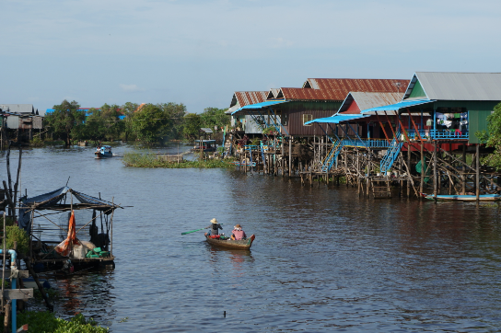
Life on water adapted for the seasonal rising and falling of water levels in Kampong Phluk, Siem Reap Province. (Credit: Ming Li Yong)
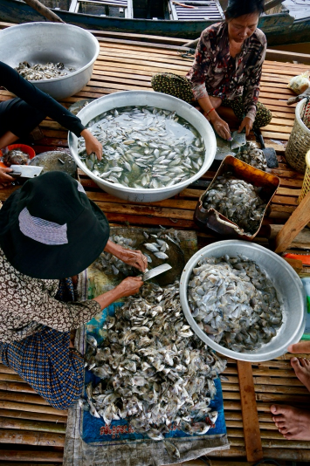
Women in Kampong Phluk processing “Trey Riel”, a critical component in the Tonle Sap’s ecological productivity, fisheries, economy, and culture. (Credit: Ming Li Yong)
Abstract
The Tonle Sap Lake in Cambodia is Southeast Asia’s largest freshwater body, and for centuries, life and livelihoods on the lake have adapted to the Mekong River’s floodpulse, characterized by the seasonal rising and falling of waters, alongside the dramatic expansion and contraction of the lake. However, in recent decades the Mekong River’s floodpulse has been anthropogenically altered by large-scale development driven by economic imperatives in the transboundary Mekong River basin, such as hydropower development, and the impacts of climate change.
In this study, the fading floodpulse of the Mekong River is conceptualized as a slow disaster for Tonle Sap Lake inhabitants (the neak tonle), exacerbating decades-long struggles with declining fish catches and flooded forest, and the uneven enforcement of conservation rules. Current development trajectories are interrogated as a form of “defuturing”, which poses an existential crisis for lake inhabitants. This crisis is embedded within profound socio-ecological change and an ongoing sense of loss, uncertainty, and precarity.
Though investigating diverse values associated with life on water, this study seeks to understand whether life on water can continue to meet community aspirations for a good life. In doing so, the following questions are raised: What happens when life on the Tonle Sap Lake is no longer perceived as tenable? What biocultural and sociocultural values are lost, beyond just economic terms? What relational values, situated within human-nature relationships, do Tonle Sap lake communities view as critical to meet their aspirations for a good life on water, and how can efforts at “futuring” be designed to offer alternative development trajectories?
Incorporating seasonal, longitudinal, and intergenerational perspectives, participatory methodologies, and a focus on community-based ecotourism and conservation initiatives centered on flooded forests and fisheries, this study also seeks to understand how diverse values, knowledge systems, and persistence can offer directions and hope for the future.
Author: Ming Li Yong
Lecturer, College of Interdisciplinary & Experiential Learning
Singapore University of Social Sciences
Adjunct Fellow at the East-West Center
University of Hawaiʻi. Full Bio. [Here]
