
Understanding the Social Impacts of Forest Fires and Transboundary Haze in Kalimantan, Indonesia By Daisuke Naito
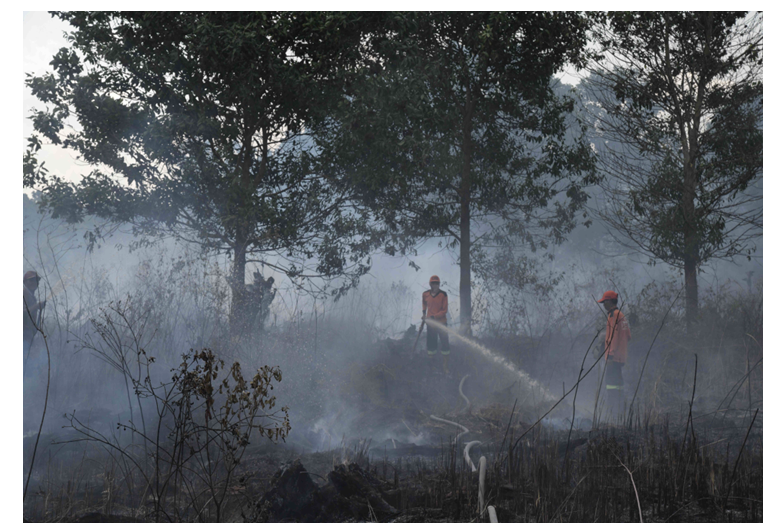
Photo By:Daisuke Naito_Suppressing peatland fire in C.Kalimanta
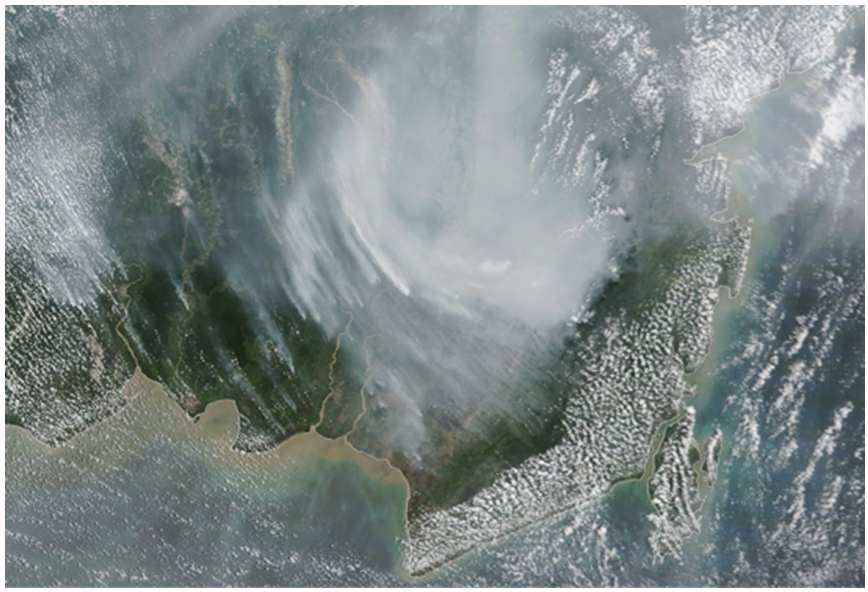
Photo By: NASA, Peatland fires and haze in 2023, [Link]
Abstract
Deforestation and peatland degradation are global environmental problems that need to be understood in both their social and ecological contexts. Forest and peat clearing for agriculture and other forms of development, alongside forest degradation from the over-extraction of timber and non-timber resources has caused rapid peat decomposition and increased incidence of forest fires in tropical countries, especially in Central Kalimantan, Indonesia. The fires, in turn, result in an increase of carbon dioxide emissions and haze, causing incalculable damage to the economy and the health of people in the region. While the effects of forest fires are wide-ranging, it is difficult to effectively evaluate their social and health impacts. To understand the social effects, an analysis of the impacts based on a detailed understanding of overall social-economic activities must be done.
Based on community surveys and key informant interviews, we will be able to accurately estimate the social and economic effects of fire and haze in Central Kalimantan. Forest fires are socio-ecological events that occur in conjunction with long-term dryness, land clearing, commercial logging, and other livelihood activities. We plan to build a comprehensive layered understanding of local and regional socio-ecological and resource-use systems. To do this, we will employ field surveys and interviews of actors in the region, including indigenous villagers, immigrant villagers, logging companies, and plantation companies, to get a comprehensive understanding of land and resource use patterns.
To understand the health impacts of haze, we will carry out in-depth studies in communities that were heavily exposed and particularly vulnerable. To do this, we will conduct joint collaborative research with local universities, hospitals and epidemiologists, to ensure that all work is done ethically and that an effective assessment of health impacts are done. In addition, we plan to introduce and assess new measures to reduce future health impacts and link these to broader local disaster mitigation and adaptation plans.
Author: Daisuke Naito,
Assistant Professor at the Laboratory of Forest Resources and Society
Graduate School of Agriculture
Kyoto University. Full Bio [Here]
Contact Email: naito.dasuke.3e@kyoto-u.ac.jp